
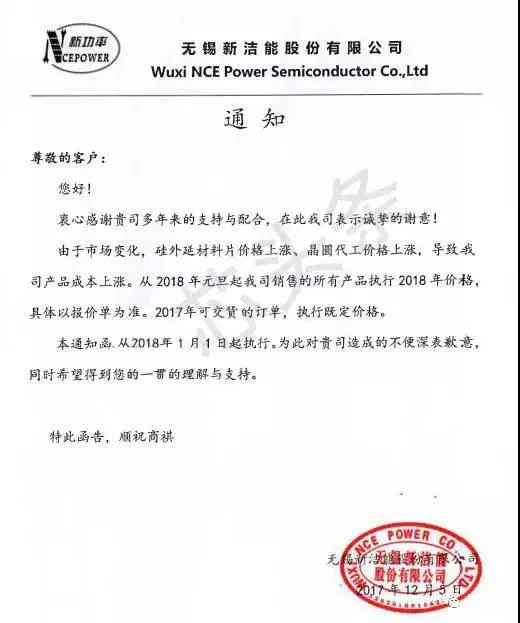
Recently, I believe everyone has heard the news that original manufacturer Wuxi NCE Power issued a price increase notice. In fact, 2017 was a year of severe shortages of electronic components; DRAM, NAND Flash, MLCC and MOSFET were component categories with relatively large and obvious shortages and price increases.
Original manufacturer Wuxi NCE Power issued a price increase notice: Due to market changes, the prices of silicon epitaxial material wafers have risen, and wafer foundry prices have risen, causing our company's product costs to rise. From New Year's Day 2018, all products sold by our company will implement 2018 prices, subject to the quotation sheet. Orders deliverable in 2017 will implement the established prices. According to industry news, the price increase is estimated at around 10%.
MOSFET packaging and testing major manufacturer Jiangsu JCET has issued 2 price increase notices, with cumulative increases of 10-30%, and Taiwan Fu Ding's increase is also as high as 10-20%. So, what reasons have caused the obvious price adjustment of MOSFET?
Main reasons
1. The rise in silicon material prices has led to high wafer prices, and corresponding wafer fabs such as SMIC and Hua Hong-Grace have also raised prices;
2. The prices of materials required for packaging and testing have also continued to rise, and packaging and testing plants such as JCET and Lanjian have also risen accordingly;
3. Demand for fingerprint identification chips and third-generation ID card ICs has grown explosively, and the profit in this area is more considerable than that of MOSFET; wafer fabs and packaging and testing plants have shifted more capacity to fingerprint identification chips and third-generation ID card chips, directly leading to a shortage of MOSFET supply, and price increases have become inevitable.
Reasons for MOSFET price increases
1. Determined by market supply and demand factors, domestic demand for MOSFET has risen significantly; supply falls short of demand, and price increases have become inevitable;
2. Foreign brands have abandoned the low-power MOSFET market they once dominated, resulting in insufficient supply for consumer electronics and LED lighting applications;
3. Japanese and US companies have controlled the supply of silicon wafers to the domestic market.
Some industry people said that downstream demand is strong and lead times for power semiconductor devices have lengthened. MOSFET lead times are generally around 8 weeks, but starting in September lead times have been stretched to more than 20 weeks. End manufacturers, in order to secure supply, are willing to pay extra to grab goods, causing MOSFET prices to rise high.
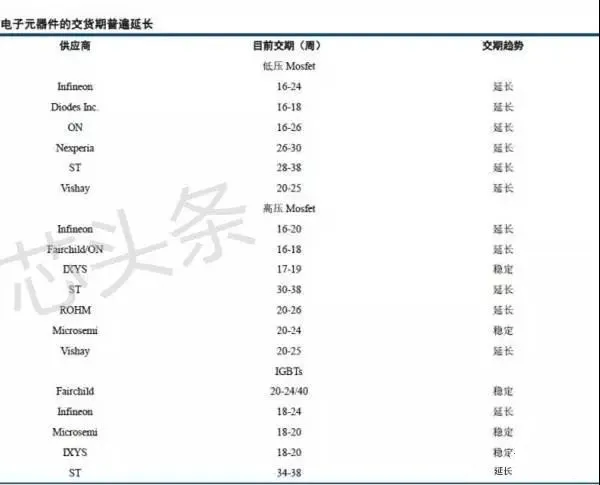
Lead times for electronic components are generally extended
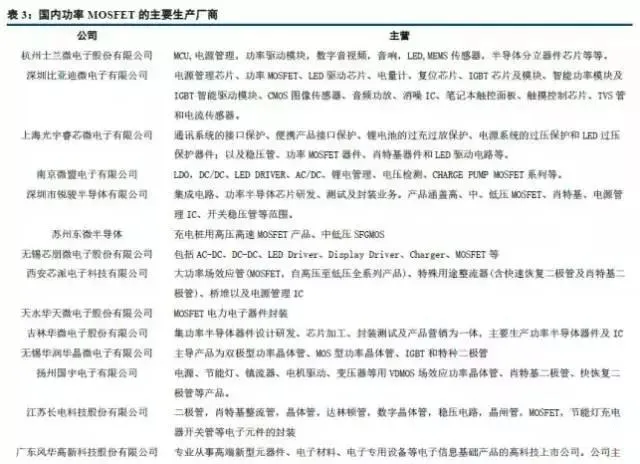
Major domestic power MOSFET manufacturers
Lead time status of major component original manufacturers
1. Discrete devices
Products include high/low-voltage/small-signal MOSFET, IGBT, ESD, varistors, thyristors, TVS/Zener/Schottky/switching/diodes, bridge rectifiers, optocouplers, logic devices, and digital/bipolar/general-purpose transistors, etc.
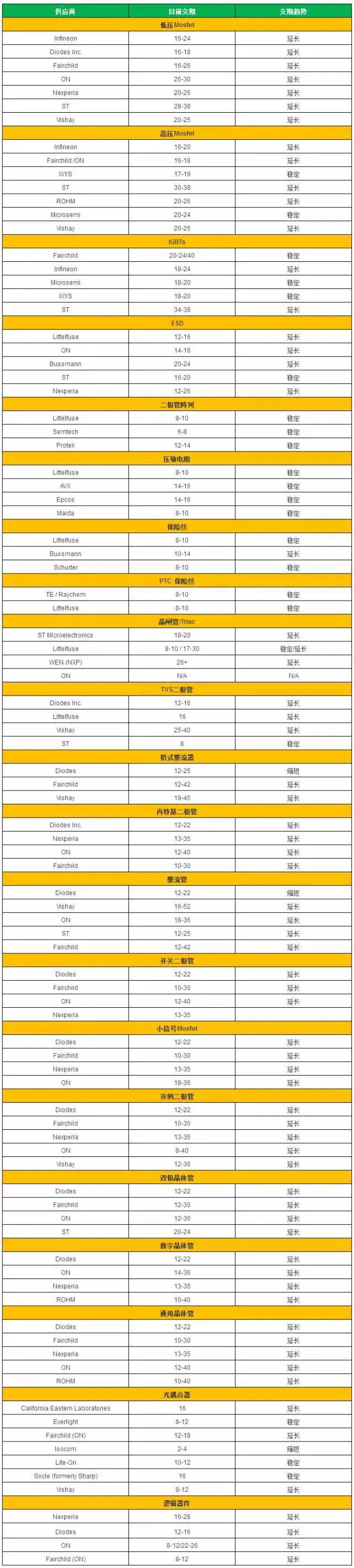
Low-voltage MOSFET: Lead times of major suppliers are all in an extended state. Among them, ST (STMicroelectronics) currently has lead times of 28-38 weeks; the main reason for the extension is that it is focused on F7 and H7 series products using new manufacturing processes, resulting in current capacity running at full load.
Diodes currently has lead times of 16-18 weeks; customers can shorten standard lead times through internal allocation.
Fairchild lead times are 16-26 weeks. Because of previous Fab factory transfer and die issues (most problems occurred in smaller packages SSot-23, Sc-70 and automotive devices), delivery problems still exist. In addition, Fairchild and ON will merge systems in the next quarter, and lead times are expected to be further extended.
Vishay currently has lead times of 20-25 weeks, and there is still a trend of extension in the future.
Nexperia currently has lead times of 20-26 weeks. Because the tablet market is quite optimistic and has successfully driven demand for micro leadless package devices, and in addition automotive device capacity is limited, future lead times still have a trend of extension.
High-voltage MOSFET: Because Ixys is in an integration period after being acquired by Littelfuse, niche, ultra-high-voltage, and high-current devices are all produced according to orders, so lead times need to be waited for. Moreover, its capacity is currently full, lead times are difficult to improve, and products above 1000V have advantages. ST currently has relatively good specifications and prices for M2, M5 and K5 series, and increased demand has caused some delivery problems.
IGBT: Fairchild currently has lead times of 20-24 weeks. Due to back-end capacity constraints caused by high demand for technology, IPM module lead times will increase from 14 weeks to 40 weeks. Infineon's CO-Pack products (rectifier combination) have lead times of more than 20 weeks. ST STMicroelectronics currently has generally long lead times, and capacity for the next 6 months is already fully loaded.
ESD: ON's SOT-223 package lead times are 20+ weeks, while Nexperia's SOT23SD/DD has extended from 8 weeks to 13 weeks; SOD523 from 8 weeks to 16 weeks; SOT323SD/DD from 8 weeks to 16 weeks; SOT363 from 8 weeks to 13 weeks; DHVQFN14/16/20/24 from 8 weeks to 16 weeks; DFN package is 20 weeks; SOD323 is 26 weeks; SOT223 is 20 weeks; DSN package is 20 weeks; SOT66X is 20 weeks; SOT457 is 13 weeks.
Thyristor/Triac: Lead times for some ST products have extended to 20 weeks, but lead times for some products can still remain at 8-12 weeks. In 2016, Littelfuse announced the acquisition of three ON Semiconductor product lines: including TVS diodes, switching thyristors and ignition IGBT. Therefore, lead times for some original ON Semiconductor products have extended from 17 weeks to 30 weeks.
TVS diodes: Littelfuse has acquired ON Semiconductor's TVS business, with lead times of 24 weeks. Vishay's SMC is 25 weeks, and SMA and SMB are both 40 weeks.
Bridge rectifiers: Because Diodes' KFAB wafer fab will close in November, production is currently being transferred to third-party wafer fabs. In the past quarter, lead times for some Diodes products had shortened somewhat, but due to the wafer fab change, lead times may be extended again.
Rectifier diodes: Lead times for Vishay's SMA, SMB, SMC, TO-220, TO-263 and DPAK have extended. Among them, Schottky is most affected, with lead times of 40-52 weeks. ON Semiconductor SOT223 and SOD123 are 26+ weeks and will continue until the first quarter of 2018. SMC package is 28 weeks, and some SMB packages are 20-26 weeks. STMicroelectronics SiC is 24+ weeks, FERDxx products are 25+ weeks, and TO-220, TO-220AC and TO-220IT are 14-16 weeks.
Switching diodes: For the extension of Diodes' lead times, refer to the above reasons. Nexperia currently has lead times of 13-35 weeks.
Small-signal MOSFET: For the extension of Diodes' lead times, refer to the above reasons. Fairchild's SS84 is 31 weeks - BSS123 is 21 weeks, and BSS138 is 46 weeks.
Optocouplers: Fairchild (ON)'s 8-pin white package lead times are 32 weeks. Isocom is eager to increase market share, and lead times are generally two weeks, sometimes shorter. Lite-On's current prices and lead times are relatively stable; Vishay's 4-pin, 6-pin, minflat and half-pitch miniflat lead times are as long as 16 to 20 weeks.
Logic devices: Lead times for ON's traditional "wide-body logic" devices have extended. US8 package is up to 26 weeks. After Fairchild was acquired by ON Semiconductor, certain traditional FCS logic devices (original AC/ACT and LCX series) have extended to 48 weeks, but ON Semiconductor has alternative materials.
2. Analog devices
Products include sensors, mixed-signal amplifiers and comparators, standard analog devices, timing, interfaces, AC/DC and DC/DC converters, etc.
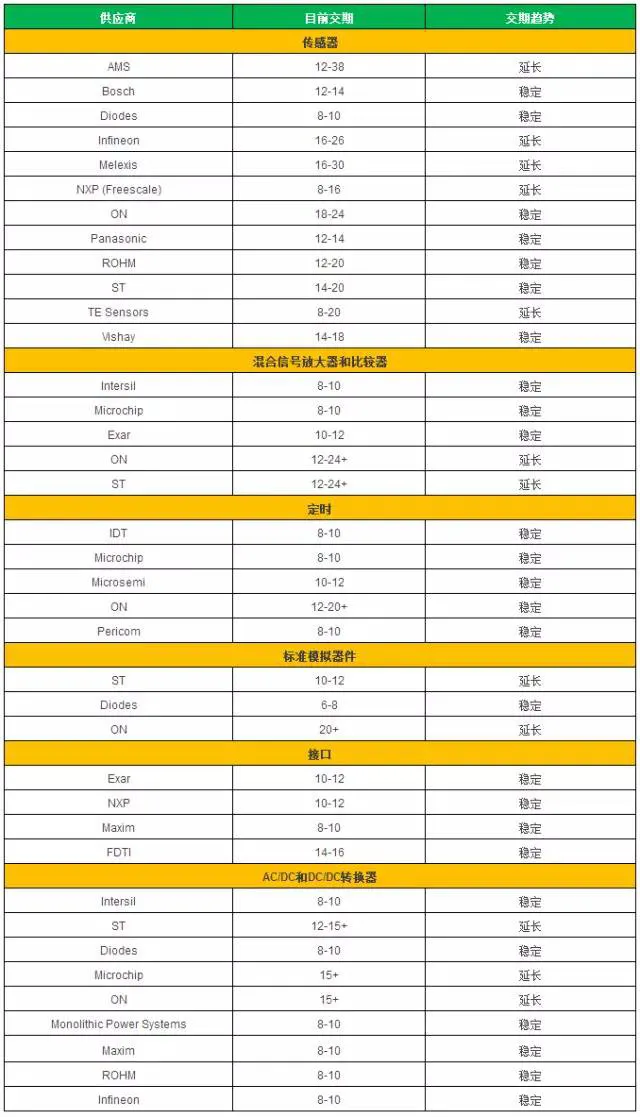
Sensors: AMS lead times are 12-38 weeks. Products with extended lead times mainly include: CMOSIS image sensors, with lead times of 22-38 weeks; position and temperature sensors, with lead times of 22-24 weeks; smart lighting managers, at 16-18 weeks. Products with relatively stable lead times: TAOS products (TSL, TMD, TCS) are 16 weeks, and CambridgeCMOS (CCS801, CCS811) are 12-14 weeks.
Bosch lead times are 12-14 weeks. The lead times of the factory producing the products are generally 12 weeks, excluding transportation time from Germany to North America.
For Infineon, lead times will be extended by an average of 2-4 weeks. Current, position and speed sensors are 16-26 weeks, and pressure sensors are 14 weeks.
Melexis's optical sensors have lead times of 18 weeks; current and position sensors are 30 weeks, latches and switches are 24 weeks; pressure sensors are 28 weeks, speed and temperature sensors are 20 weeks; hardware and tools require only 4-6 weeks.
NXP accelerometers and pressure sensors/TPMS have extended to 16 weeks, and other sensors are stable at 8 weeks.
ST's MEMS sensors are stable at 20-22 weeks, temperature sensors are stable at 14-16 weeks, and time-of-flight sensors are 14 weeks. Vishay's digital sensor series lead times are 14-18 weeks.
Mixed-signal amplifiers and comparators: Lead times for Intersil, Microchip, and Exar (acquired by Maxlinear) are currently all very stable, usually at 8-10 weeks. Some series from ON and ST have lead times of 20+ weeks.
Timing: Lead times of all original manufacturers are very stable; only some ON series have lead times reaching 20+ weeks. Pericom has been acquired by Diodes, but prices and lead times currently have no change.
Standard analog devices: Most ST products have lead times of 10-12 weeks, while D2Pak lead times are 25-35 weeks. Diodes lead times have begun to extend, up to 16 weeks; some ON series have lead times reaching 20+ weeks.
AC/DC and DC/DC converters: Intersil lead times are stable at 8-10 weeks; ST automotive VNX series lead times reach 24+ weeks, and some DC/DC lead times are extended. Certain Diodes series lead times have extended to 20 weeks. ON currently has lead times of 15+ weeks, and some products have extended lead times, especially automotive-grade products. Others such as Maxim, ROHM and Infineon have stable lead times.
3. Memory
Products include DRAM, SRAM, NOR flash, SLCNAND flash, eMMC, SSD, MRAM, E/EEPROM, FRAM and NVSRAM, etc.
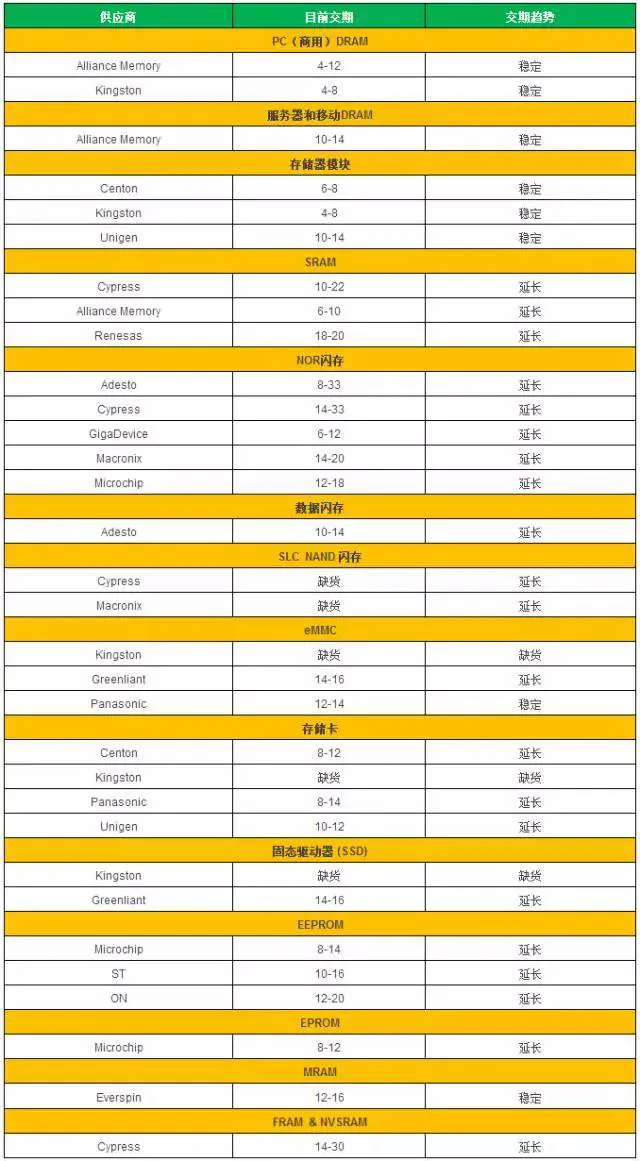
From the above data, it can be seen that in the fourth quarter of 2017, most lead times for memory products were extended, and many categories of products from Kingston and Cypress are currently in a shortage state. Among them, Cypress NOR flash is severely in shortage, and prices in the fourth quarter are expected to increase by an average of 20% compared with the third quarter.
SLCNAND flash: Cypress and Macronix's SLCNAND products are in shortage. Compared with the third quarter of 2017, the cost of SLCNAND flash devices has increased by 150%.
eMMC: Kingston eMMC is currently severely out of stock, with 8GB most severely affected.
Memory modules: DDR4 current pricing is almost double compared with last year, with an increase of 8%-18% from the second quarter of 2017 to the third quarter of 2017. DDR3 modules are also in shortage, with costs 80% higher than last year. However, it is worth mentioning that from the second quarter to the third quarter, for most configurations, cost growth was only about 5%. DDR2 module prices and lead times are relatively stable. Lead times are 2-3 weeks, and costs have remained unchanged for more than a year.
4. Multilayer ceramic capacitors
Products include surface-mount general-purpose ceramic capacitors, leaded ceramic capacitors and special capacitors.
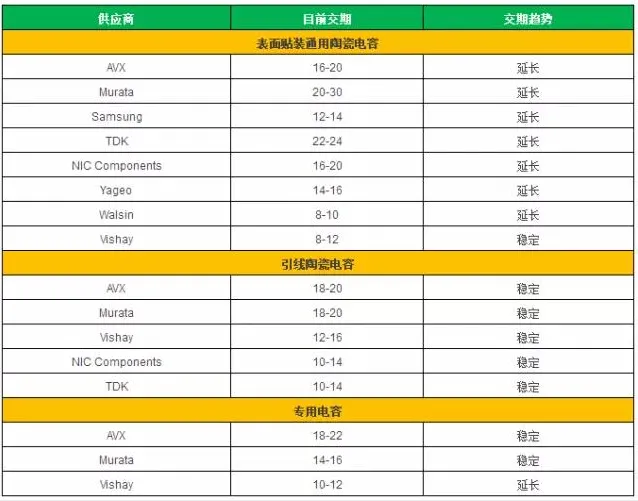
Surface-mount general-purpose ceramic capacitors: Murata currently has lead times of 20-30 weeks; many device original manufacturers have stopped accepting orders, most of which are large-size devices. Samsung and Yageo lead times will still be extended, and TDK is severely out of stock for this part of products.
Leaded ceramic capacitors: Many Murata devices have been discontinued.
5. Connectors
Products include plastic multi-pole edge connectors, D-Sub connectors, PCB connectors, RF connectors, lighting connectors, etc.
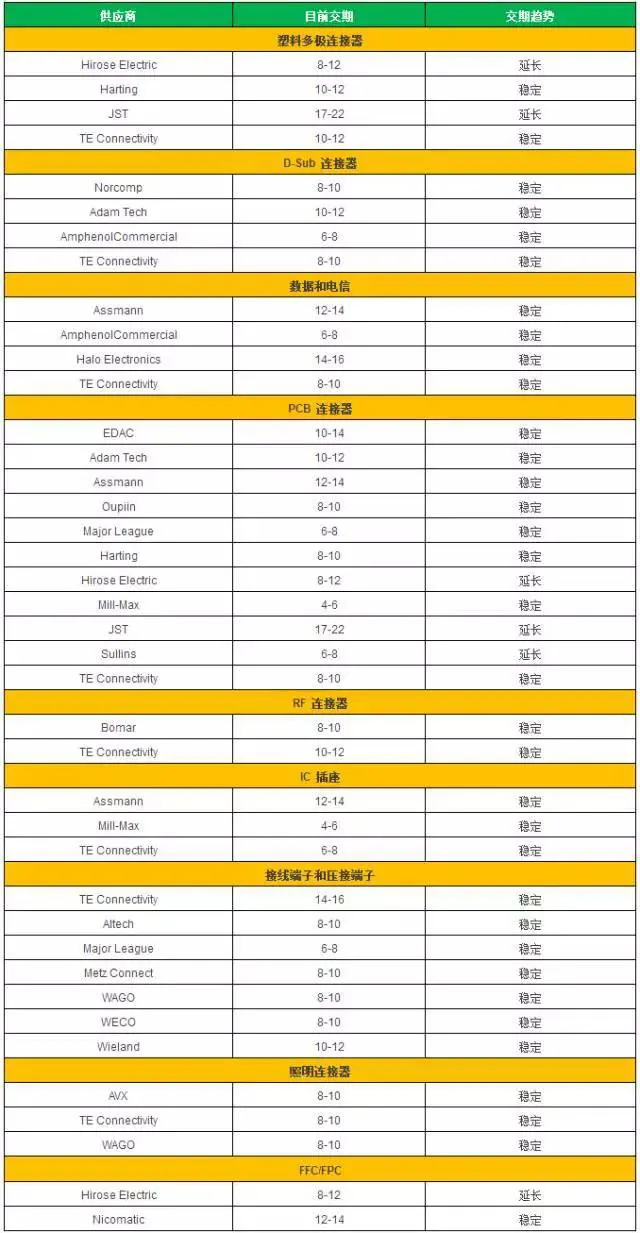
In the fourth quarter of 2017, lead times of major connector suppliers tended to be stable, and lead times of some products were extended due to raw material shortages.
6. Passive devices
Products include trimming resistors and potentiometers, electrolytic capacitors, film capacitors, tantalum capacitors, filters, inductors, fixed resistors, resistor networks, etc. (For surface-mount general-purpose ceramic capacitors, leaded ceramic capacitors and special capacitors, please refer to the above data; they are omitted here.)
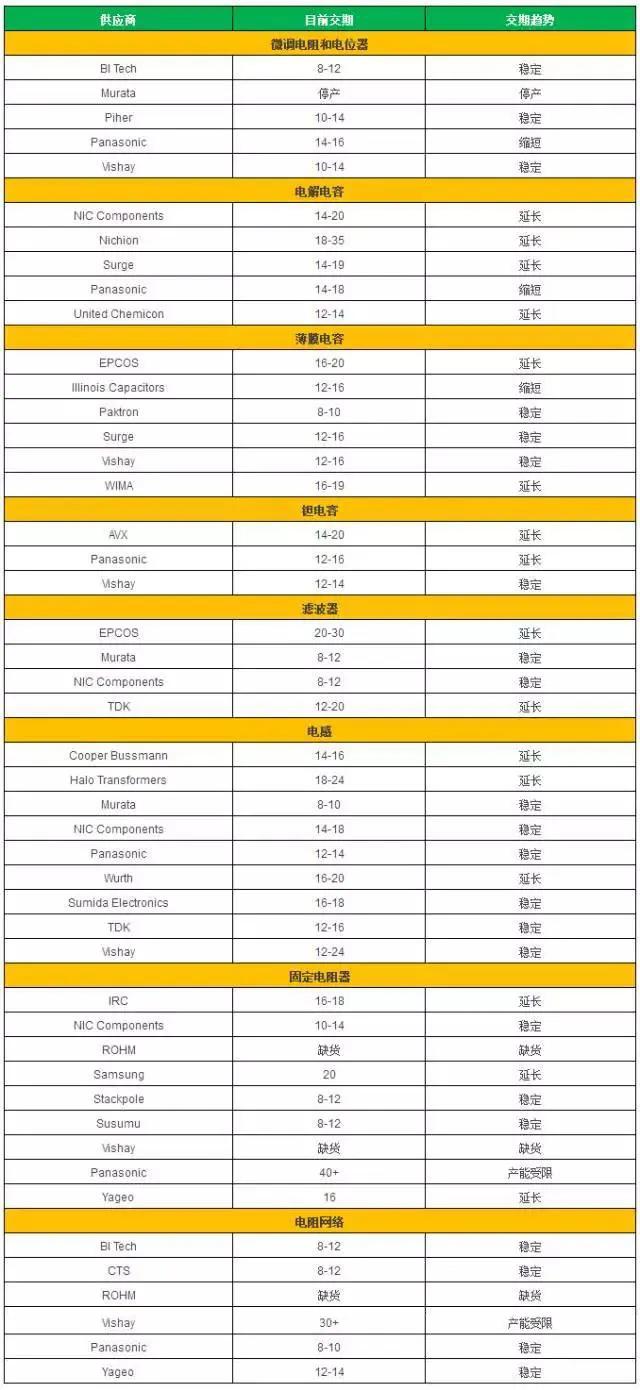
Trimming resistors and potentiometers: Murata has discontinued this part of products, and Panasonic's potentiometers will also be discontinued at the end of 2017.
Fixed resistors: Affected by capacity constraints, lead times for many IRC and Panasonic products will be extended. ROHM is also temporarily unable to supply due to Rchip capacity issues. Vishay's Rchip capacity also has problems, lead times are extended, and the CRCW series is currently out of stock.
7. RF and wireless
Products include Wi-Fi modules, Bluetooth modules, zigbee modules, cellular modules, antennas, transceivers/receivers, RFID, etc.
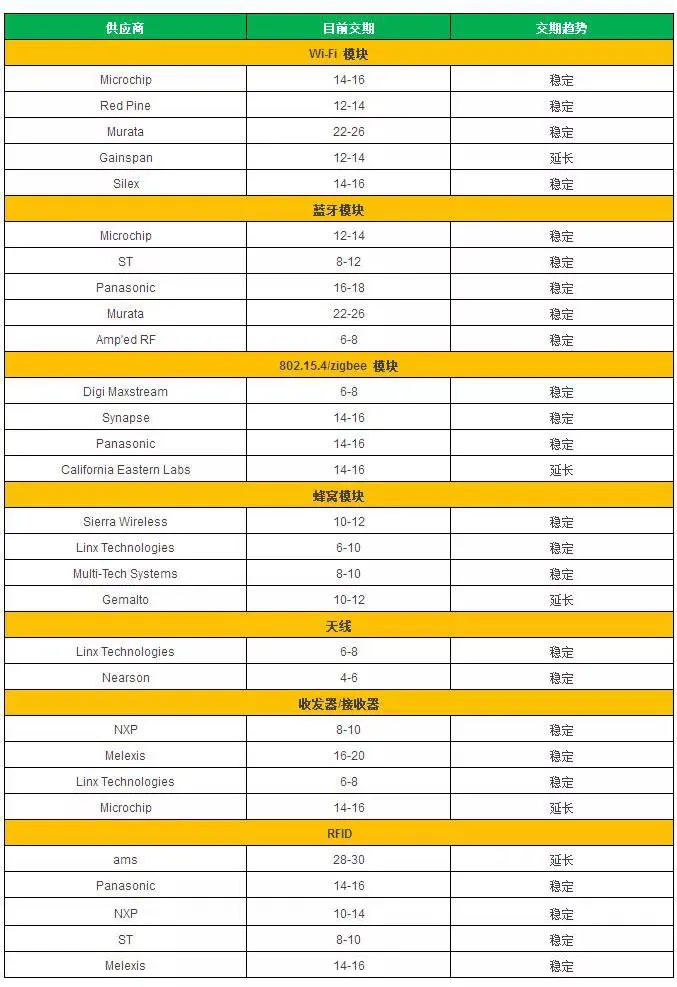
Wi-Fi modules: RedPine RS9113 module lead times have shortened to 12-14 weeks, and the older RS9110 series lead times are still as long as 20-22 weeks. Gainspan GS10 series have extended to 18-20 weeks.
8. Battery components
Products include alkaline batteries, lithium metal batteries, lithium-ion batteries, nickel-metal hydride batteries, lead-acid batteries, silver oxide batteries, carbon-zinc batteries, etc.
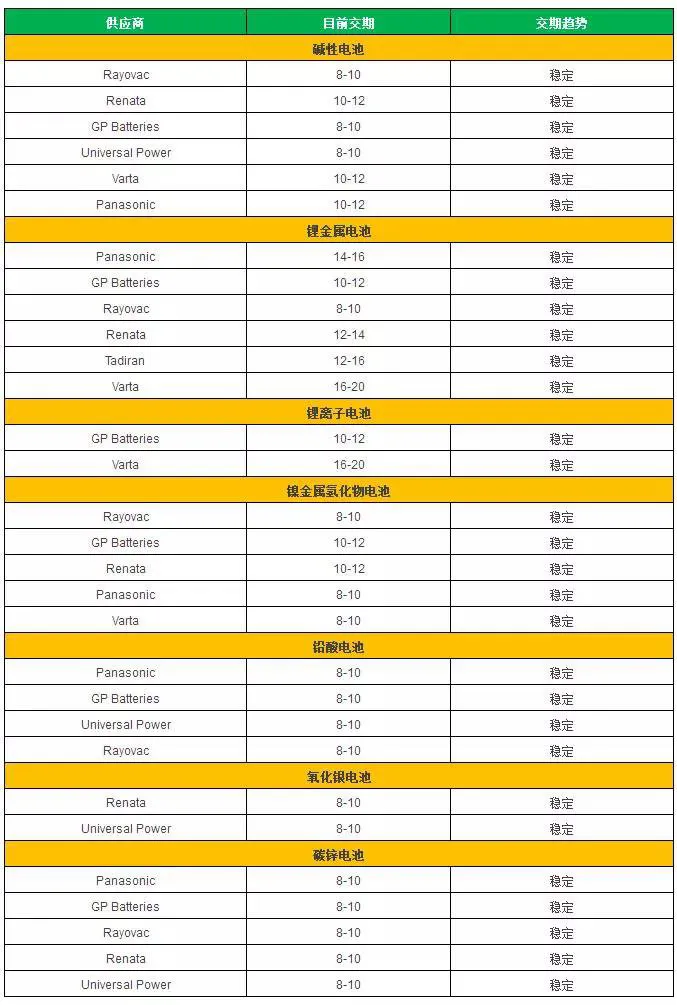
In the fourth quarter of 2017, lead times for battery-related components were generally stable between 8-10/10-12 weeks.
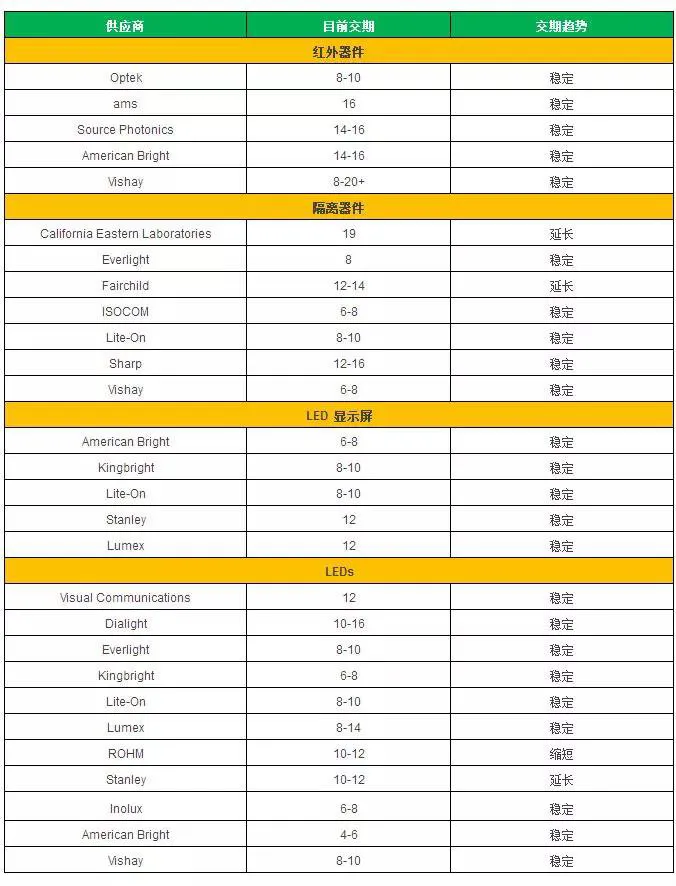
9. Optoelectronic devices
Products include infrared devices, isolation devices, LED displays, etc.
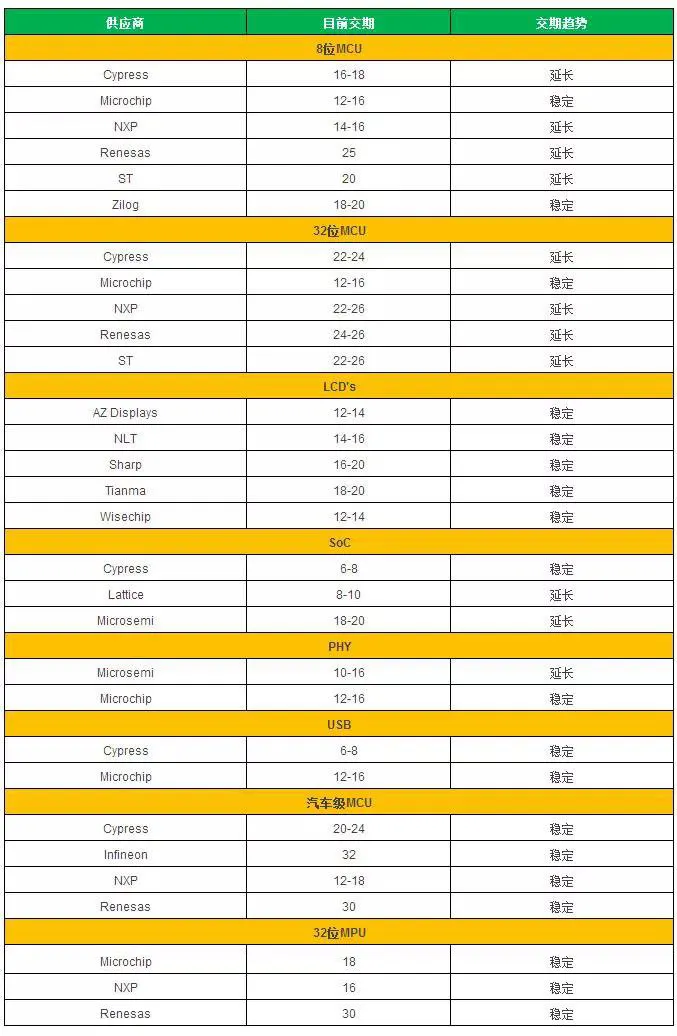
10. High-end devices
Products include 8/32-bit MCU, 32-bit MPU, SoC, PHY, USB, automotive-grade MCU, etc.
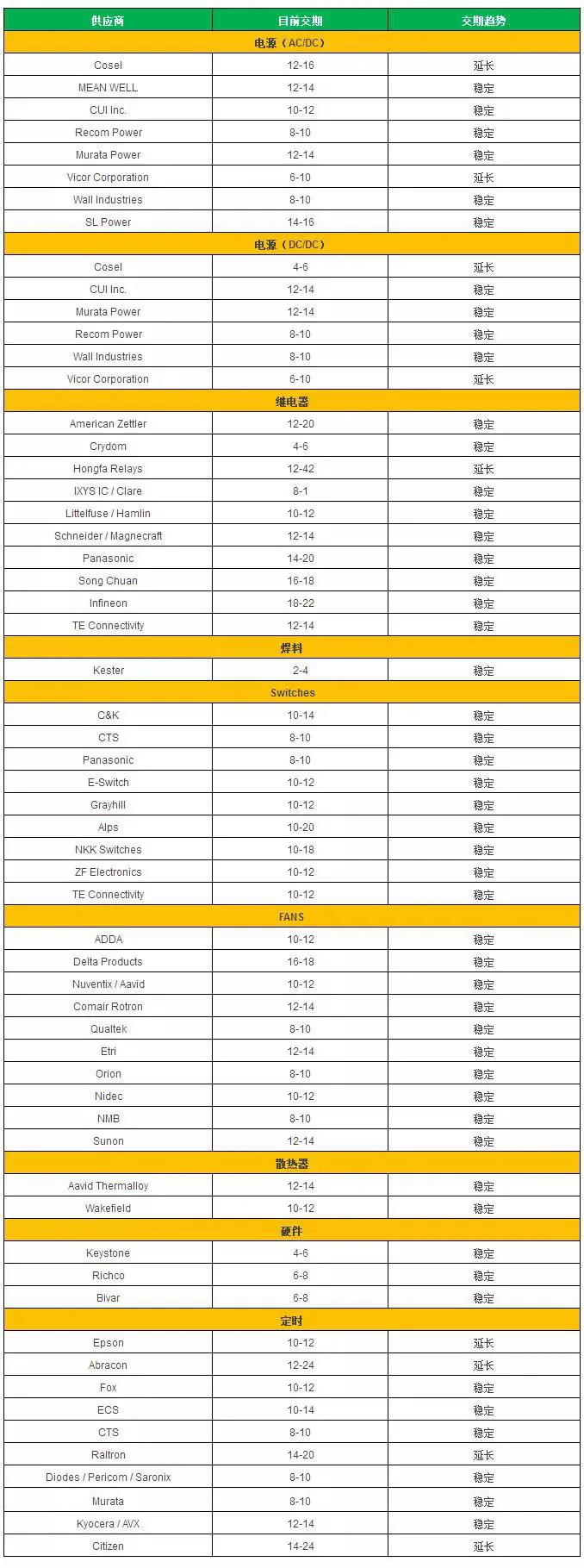
11. Electromechanical
Products include power supplies, relays, heat sinks, Switches, etc.
12. Lighting solution devices
Products include LED arrays, chip-on-board, high-power LED, medium-power LED, standard light engines, etc.
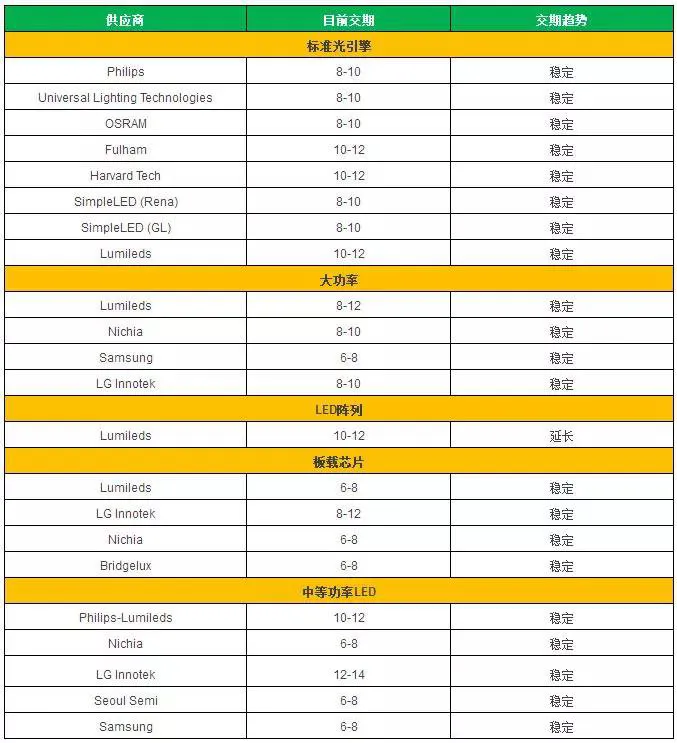
In the fourth quarter of this year, lead times for related lighting devices almost all tended to be stable, remaining at the normal level of 6-8 weeks or 10-12 weeks.